Practical karaoke · Connection guide
Karaoke Machine for Adults: Try a Three-Song Party Handoff
This is an original buying worksheet, not a product ranking or hands-on performance test.
Write the evening you are buying for
Start with the people and decisions rather than an age label on a product listing. Will one person run every song, or will guests take turns choosing tracks? Will singers read one shared screen or use their own device? Is a duet an occasional extra or the normal arrangement? Write one answer to each question before you compare offers.
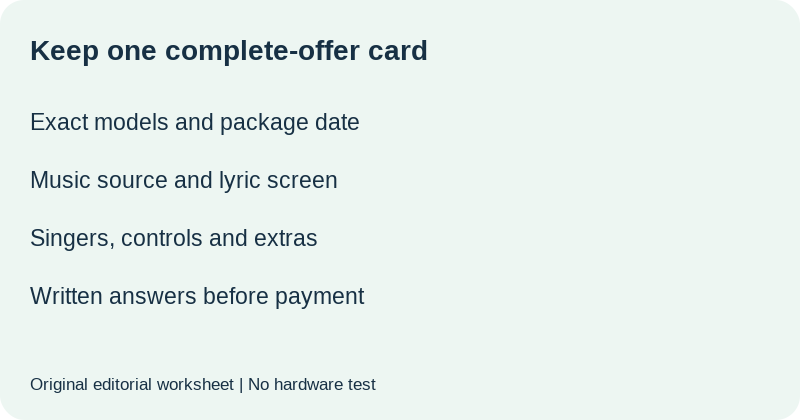
For a karaoke machine for party use, the useful comparison is the complete arrangement you will actually operate. A package with more accessories can still leave your song-changing plan unresolved. Keep the source device, lyric display, microphone arrangement and person operating the controls on the same purchase card.
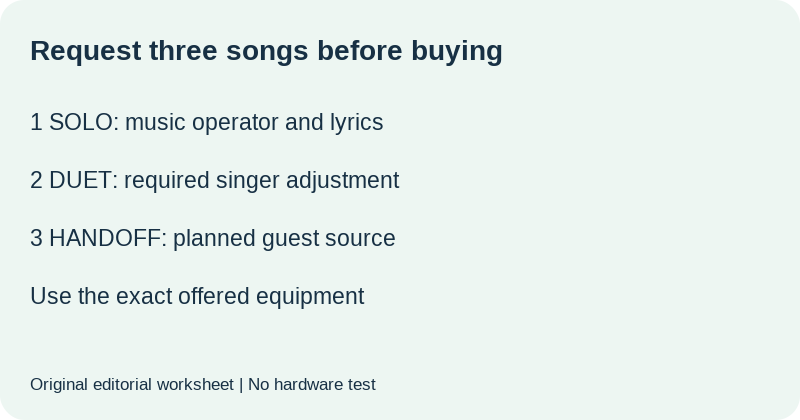
Song one: keep the first singer independent of the menu
Ask the seller to start the music and put the lyrics where the singer will see them. Then have the proposed host choose the next song while the singer stays in place. The purpose is to see the operating sequence. Record who holds the device, who can reach the controls and what the singer needs to stop doing when the host changes a setting.
If your evening uses one host device, keep it in the demonstration. If guests bring phones, identify the actual device and app you intend to use for the second part. A demonstration using the seller's different source does not answer an unresolved question about your own source.
Song two: change the duet arrangement
Ask for both intended microphones to be used with the backing track. Have the seller identify the control for each microphone and the control for the music. If one singer needs a different level, ask for that adjustment while the other singer continues. Record whether the control acts on one voice, both voices or the overall output.
You are requesting a demonstration of a buying requirement. You are not establishing an acoustic measurement or a universal performance result. If the seller needs a different receiver or mixer to meet your requirement, write that item onto the complete offer rather than treating it as already included.
Song three: hand the music choice to another guest
Choose the handoff you actually expect: another person selecting a song on the same device, or another guest using a different source device. Ask the seller to walk through that exact change. Write down which connections or settings change, where the lyrics remain visible and whether the host needs to intervene.
Keep a simple record with three columns: action requested, what the seller demonstrated, and what remains unconfirmed. An unanswered step is a question to resolve before payment. Avoid giving an offer a pass merely because its first song sounded enjoyable on the sales counter.
What the manufacturer evidence does and does not settle
JBL's wireless microphone information lists different microphone arrangements by PartyBox model. Some use a receiver dongle and a microphone input; bundled microphone behavior also depends on the model. That is a reason to match the offered speaker, microphones and receiver to the applicable row, not assume that every two-microphone bundle works the same way.
The FIFINE K036 product page describes a dual wireless microphone system and independent volume controls. That description identifies one component's stated features. It does not by itself confirm the whole music, speaker and lyric arrangement you intend to buy. Neither source establishes a single best karaoke machine for adults.
Send this specific request before ordering
I am comparing your [full model and package] for an adult karaoke evening. Our song plan is [one host device or guest source changes], lyrics are on [screen], and we need [solo or duet arrangement]. Please demonstrate one solo song, two singers with the required voice adjustment, and our planned guest handoff. Name every speaker, microphone, receiver and adapter used. Which items are included in this exact offer, and which must we supply? Please link the applicable manufacturer instructions and answer any step you cannot demonstrate.
Make the purchase decision from the complete offer
Continue when the three requested sequences match the evening you wrote down and all required equipment is identified. Compare the seller's complete package rather than an isolated microphone or speaker price. Keep the model names, written answers and offer date together. When a substitute is proposed, recheck the changed component and the affected sequence before accepting it.
If the larger question is whether to reuse your existing room equipment or buy a complete package, use the home system decision guide. For this page, keep the decision focused on the operating sequence of a multi-person evening.
Watch the three-song buying worksheet
Original editorial graphics and synthetic English narration. No hardware test.
Quick answers
Does an adult karaoke party need a dedicated host?
Choose one host or a guest-operated arrangement before comparing offers, then ask for that sequence to be demonstrated. This worksheet does not require a particular staffing choice.
Does a two-microphone offer prove independent singer controls?
No. Identify the exact speaker, microphones and receiver, read their applicable instructions and request the adjustment you need.
Should every guest reconnect their own phone?
Only if that is the source-changing workflow you choose and have confirmed for the exact setup. Selecting songs on one host device is a separate operating plan.
Manufacturer pages checked 23 November 2026. This is document-based purchasing guidance with an original editorial rehearsal, not a measured comparison.