Practical karaoke · Connection guide
Karaoke Mixer: What to Check Before You Buy
This is an equipment buying guide. It does not rank untested products or walk through a complete room installation. If you are still deciding whether to buy a whole package, start with our karaoke set for home decision page.
What a documented karaoke mixing system can include
The official FIFINE K036 product page describes pre-paired microphones, independent volume controls and an echo effect. Its home-theater instructions document feeding TV audio to the system and sending mixed audio onward to compatible amplified equipment. They distinguish analog TV output from an optical route requiring conversion.
These are facts about one documented model, not universal mixer specifications. They illustrate why a product sold as a microphone system can include mixing functions. We have not tested this unit. Verify the exact model and package rather than treating every product called a karaoke mixer as interchangeable.
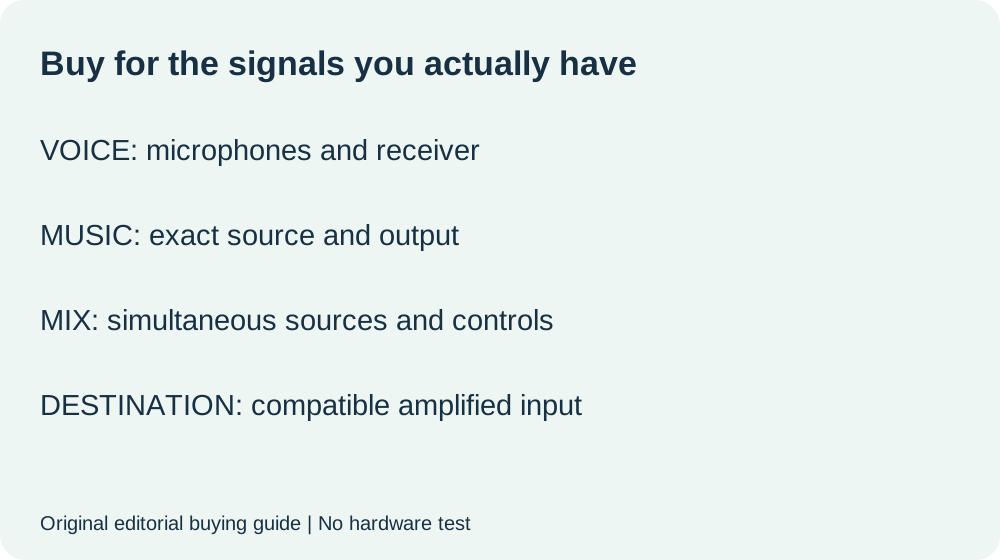
Make an input-and-output shopping card
A useful product comparison starts with your sources, not a count of knobs. Give every source its own row. Two people singing simultaneously is a different requirement from one person switching between two microphones. Write down the simultaneous use you want so the seller can address that requirement explicitly.
| Requirement | Record before shopping |
|---|---|
| Voice sources | Microphone models, any existing receiver, and number used simultaneously |
| Backing music | Exact source device and its documented audio output |
| Mixed output | Destination model and its accepted input |
| Controls you need | Which voice or music level you need to adjust separately |
| Unconfirmed points | Write unknown; do not assume compatibility or enter a zero cost |
If you already own wireless microphones, identify the receiver that belongs to them. Do not buy a mixer on the assumption that it will receive an unspecified wireless microphone directly. If the product includes its own microphones, compare that package with reusing yours before paying for both.
Compare three equipment roles, not three price winners
A microphone system with mixing functions
Investigate this when you need microphones and a documented way to combine their voice signal with music. Ask whether the package includes the microphones you need and which connections remain your responsibility. The included functions may remove the need for a separate mixing box, but only for a route the documentation supports.
A separate audio mixer for karaoke
Investigate a separate mixer when you already have useful sources and need a device to combine them with suitable control. Compare its accepted signal types, simultaneous inputs and outputs against your shopping card. A larger input count has no value if your required source or audio destination is still unconfirmed.
A speaker package with suitable onboard controls
Check the equipment you already own before buying another box. If the documented speaker arrangement accepts the voice and music sources you need and provides adequate independent control for your plan, a separate mixer may solve no missing job. This is an inventory decision, not a claim that all karaoke speakers contain the same features.
Make every attractive feature answer a buying question
For separate volume controls, ask which sources they actually control. For effects, ask whether they apply to the microphone signal or another signal. For a digital connection, ask its documented purpose; the presence of a socket does not establish that it performs your intended audio task.
Keep optional recording separate from the basic purchase decision. If recording is not part of your planned use, do not make it a reason to spend more. If it is required, add an exact destination and supported route to the shopping card. A mixer label by itself does not confirm recording support.
Send the seller this mixer-specific request
Use this template after filling in the models. It asks for evidence about a proposed equipment purchase, rather than a general reassurance about karaoke compatibility.
I want to combine [number and models of microphones, plus receiver if used] with music from [source model and output]. The mixed sound must reach [amplified speaker or receiver model and input]. For [exact mixer model and package], please confirm these sources can work simultaneously, name the accepted input and output connections, and identify which voice and music levels are independently adjustable. Link the supporting manual sections. List included items and every required extra. Please mark unsupported or unverified combinations unknown.
Save the answer with the exact listing. “Works with karaoke” does not answer a question about simultaneous sources. A reply about a different mixer variant also leaves your purchase unresolved. Ask for the missing detail before buying a converter to bridge a guessed connection.
Use a purchase gate before comparing final prices
- Inputs: the exact voice and music sources are documented as supported for the intended simultaneous use.
- Output: the mixed output has a supported receiving input on your amplified audio equipment.
- Controls: the sources you want to balance have the controls you need.
- Total: each required item is included, already owned and verified, priced as an extra, or explicitly unknown.
Compare complete totals only after the first three checks are resolved. Add the mixer, any missing receiver or speaker, required connections and checkout charges. If a required item has an unknown price, your total is incomplete; it is not a cheaper route.
Choose the smallest purchase that closes a documented gap. If your present package already does the required mixing, keep it until you can name the missing capability. These are original editorial buying rules, not results from listening tests or measured product comparisons.
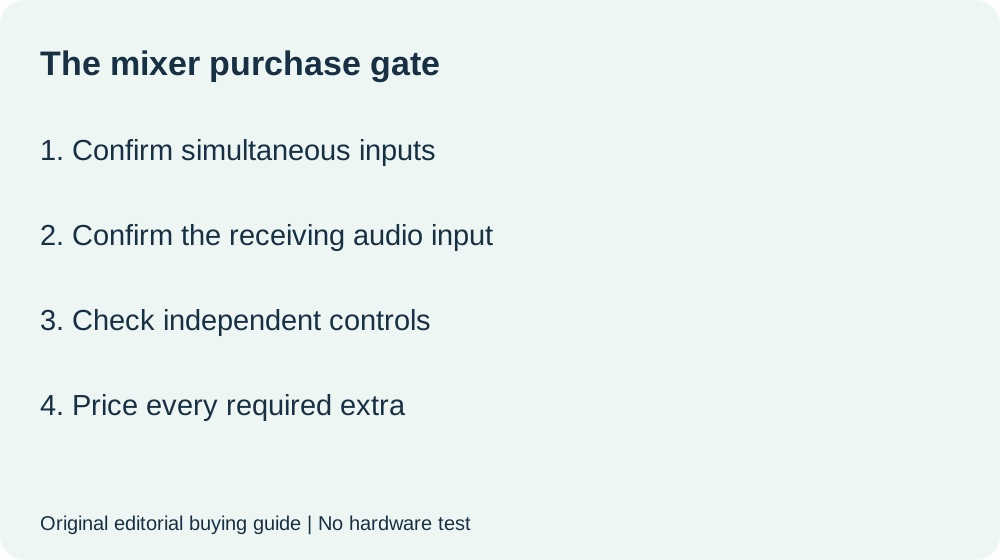
Watch the mixer purchase checks
Original editorial diagrams and synthetic English narration. No hardware demonstration or product test.
Quick answers
Do I need a karaoke sound mixer if I buy a complete set?
First identify whether the set already combines your required voice and music sources with suitable control. Buy a separate unit for a documented missing function, not because a generic equipment list includes one.
Will a mixer make passive speakers work by itself?
Do not assume amplification is included. Check the exact product and the speaker's requirements. Your shopping card needs a supported amplified destination or separately documented amplification arrangement.
Can any wireless microphone connect to a karaoke mixer?
Do not assume that. Identify the microphone system's receiver and its documented output, then compare that output with the mixer's supported input. An included wireless system is a different package from a mixer alone.
For the broader decision about what to reuse and what to buy, return to karaoke set for home. For a TV-specific purchase, use the separate TV equipment checklist.
Manufacturer pages read 25 October 2026. Shopping card, seller request, purchase gate and diagrams are original editorial work. No physical hardware test, current price comparison or measured sound-quality ranking is claimed.