Practical karaoke · Connection guide
Portable Karaoke System: Rehearse Before Changing Locations
This is an original relocation worksheet, not a hardware test. It documents a setup you have checked; it does not establish compatibility between unspecified products.
Start with the exact system, not a familiar-looking socket
JBL's Wireless Microphone Information lists different microphone arrangements for different PartyBox models. Its On-The-Go notes also describe restrictions on the bundled wireless microphone. Treat that as a reason to keep exact model names with your connection notes. Do not transfer instructions from one model to another simply because both systems are portable.
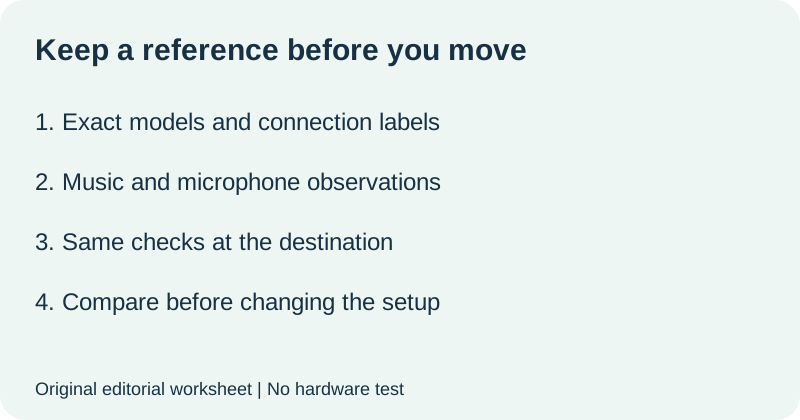
Make a reference card before disconnecting
Our original reference card separates the equipment inventory from the observed result. Write the date and location first. List the speaker, each microphone, any receiver or controller, and the music device using their complete model names. For every connection, record the label printed beside the output and input. Use the manufacturer's instructions to confirm that the arrangement is permitted.
| Reference field | Record your checked arrangement |
|---|---|
| Music route | Actual playback device, connection and selected input: ______ |
| Voice route | Microphone and receiver models, output and speaker input: ______ |
| Power plan | Required supplies and manual instructions: ______ |
| Lyrics plan | Actual display device and material you opened: ______ |
| Observed result | Music alone, each voice, then the intended combined setup: ______ |
Take your own reference photo if useful, keeping labels visible and private information out of frame. The card should let you reconstruct the arrangement without relying on memory. If a connection is still unconfirmed, label it unconfirmed rather than recording it as working.
Repeat the reference checks after the move
At the destination, check the equipment against the card before starting playback. Follow the model's setup and power instructions. Record the music result separately from each microphone result, then check the planned combination. These are editorial observation prompts, not model-specific pairing instructions.
Keep the two location records side by side. For each check, write what you heard or saw, rather than a general verdict such as good or bad. Examples of useful descriptions are music audible, voice silent, or connection indicator changed. Use only observations you actually made.
| Observation | Before move → destination |
|---|---|
| Music playback | ______ → ______ |
| Each intended microphone | ______ → ______ |
| Music and voices together | ______ → ______ |
| Lyrics visible on the actual device | ______ → ______ |
| Difference in equipment or selected input | ______ → ______ |
If the destination result differs
Write down the difference before making a change. Check whether the same devices, documented connections and selected inputs are being used. If you choose a troubleshooting step from the correct manual, record that one step and its result. Avoid changing several settings and replacing a cable together: your record would no longer identify which change corresponded with the new result.
If the model instructions do not resolve the issue, send the manufacturer a concise description containing the exact models, connection labels, before-and-after observations and steps already attempted. Do not invent a cause from the worksheet. Keep personal address and account details out of public posts.
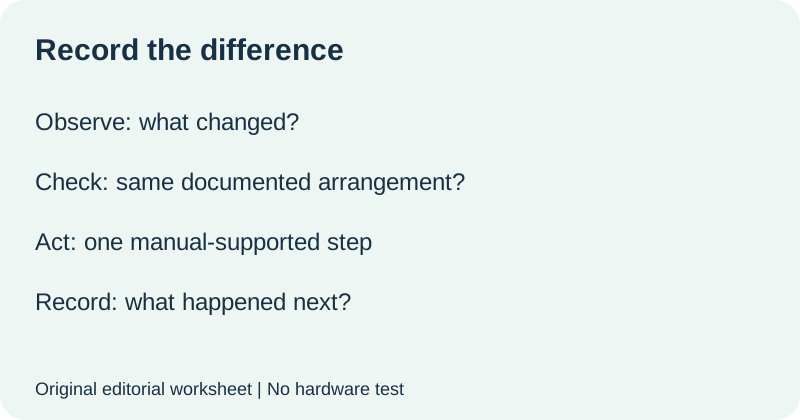
Watch the checklist
Original editorial visuals and synthetic English narration. No hardware test.
Quick answers
Does a successful rehearsal guarantee the next location will work?
No. It gives you a reference to compare. Repeat the checks with the actual destination arrangement.
Can I use another speaker's microphone instructions?
Use instructions for your exact model and accessories. The official JBL example shows why arrangements cannot be assumed identical.
How is this different from a packing checklist?
A packing checklist records what to carry. This worksheet records a working arrangement and compares results after moving it.
Official source checked 11 October 2026. Reference card, comparison table and observation workflow are original editorial materials. No equipment was tested.